Dimitrie Cantemir
Prince, scholar and composer who described the whole of Moldavia for Europe
1673-1723
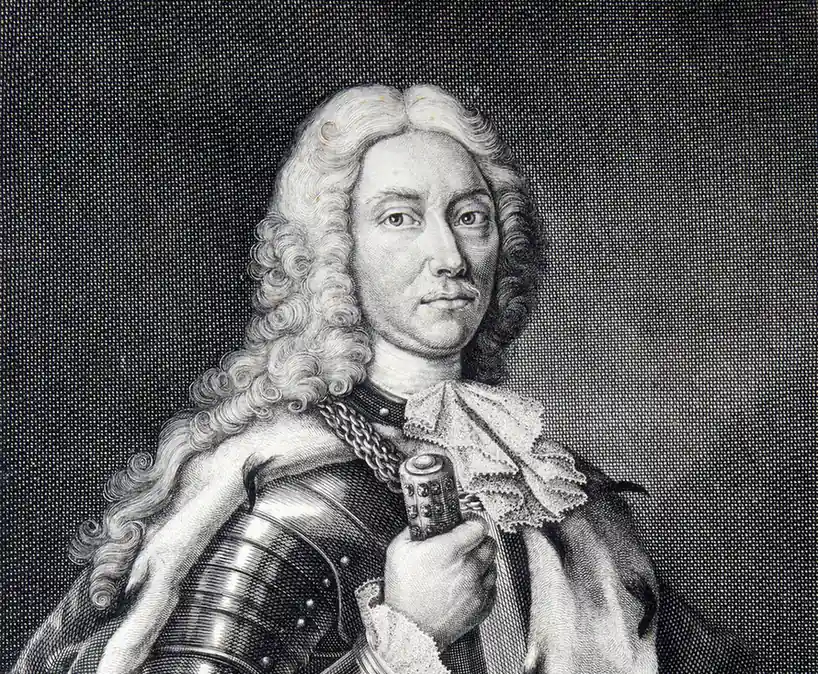
Photo: Unknown author, Public domain, via Wikimedia Commons
Dimitrie Cantemir was Prince of Moldavia, but above all one of the great scholars of his age: historian, philosopher and composer of Ottoman music. His Descriptio Moldaviae of 1714 is the first detailed description of the country, its geography and its people. In Chișinău his bust has stood in the Aleea Clasicilor since 1957.
Link with MoldovaDimitrie Cantemir was Prince of the historical Principality of Moldavia in 1693 and from 1710 to 1711, a state that also covered the territory of today's Republic of Moldova, and in 1714 he described that land in his Descriptio Moldaviae.
Cantemir was born on 26 October 1673, the son of Prince Constantin Cantemir. After his father's death he ruled for a few weeks in 1693 before being replaced. From 1687 to 1710 he lived mostly in Constantinople, partly as a hostage and partly as an envoy. There he learned Turkish, studied Ottoman history and composed. His music book for Sultan Ahmed III preserves some 350 instrumental pieces in a notation of his own invention.
In 1710 he became prince again. Through the secret Treaty of Lutsk he sided with Tsar Peter the Great, but the campaign against the Ottomans ran aground at Stănilești on the Prut in July 1711. Cantemir fled to Russia, where he was given a princely title. In 1714 he became a member of the Berlin Academy, at whose request he wrote the Descriptio Moldaviae. His history of the growth and decay of the Ottoman Empire, printed in London in 1734, made him famous throughout Europe.
The link with Moldova
The principality that Cantemir ruled and described covered both the east of present-day Romania, with its capital Iași, and the land between the Prut and the Nistru that now forms the Republic of Moldova. That is why both countries honour him as a national figure.
Where you will find him
Cantemir died on 21 August 1723 on his estate in Russia. His remains were brought to the Trei Ierarhi Church in Iași in 1935. In Chișinău his bust is one of the twelve statues with which the Aleea Clasicilor in Ștefan cel Mare Park opened in 1958.
Key facts
- Prince of Moldavia in 1693 and from 1710 to 1711
- Defeat at Stănilești in July 1711, followed by exile in Russia
- Member of the Berlin Academy in 1714
- Wrote the Descriptio Moldaviae in 1714
- Reburied in Iași in 1935